The people deported to Auschwitz were told to bring luggage. Many believed they were being resettled to work in the East, and packed what they thought they would need for a new life: clothes, shoes, bedding, kitchen utensils, tools, medicine, photographs, money and jewellery. The SS took all of it. The warehouses where the property of the murdered was sorted were called “Kanada” by the prisoners.
Why “Kanada”?
For the prisoners, Canada was a distant country of plenty. The warehouses, filled with goods that no one in the starving camp could otherwise dream of, seemed to them like that land of wealth. The name began as prisoner slang, but some members of the SS staff also came to use it.
Kanada I and Kanada II
The first storage area, later called Kanada I, was set up in the main camp and then moved to buildings near it. As the mass murder of Jews in Birkenau grew, the space was no longer enough. In December 1943 the SS opened a much larger complex in Birkenau, in sector BIIg, right next to the gas chambers and crematoria IV and V. Known as Kanada II, it consisted of 30 wooden barracks, as well as barracks for the prisoners who worked there and for the SS staff who supervised them.
The work of the Kanada commando
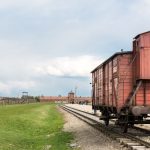
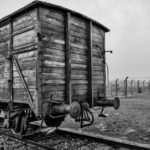
When a transport arrived at the ramp, the deportees were ordered to leave their luggage behind. Prisoners of the so-called clean-up commando loaded it onto trucks and brought it to Kanada, where other prisoners opened, sorted and packed it. Clothes, shoes, glasses, prams, suitcases and household goods each had their own place. Seams and linings were searched for hidden money and valuables.
The commando grew with the deportations. In the summer and autumn of 1944, during the murder of the Hungarian Jews, between 1,500 and 2,000 prisoners worked in Kanada II, many of them young women. Read more about these deportations in our article on Hungarian Jews in Auschwitz.
“The best work in the camp”
Among prisoners, Kanada was considered one of the best work details in Auschwitz. The work was under a roof, and despite the threat of severe punishment, prisoners managed to “organise” food, clothing and other goods for themselves and for others. Things smuggled out of Kanada were exchanged throughout the camp and saved many lives.
But the work had another side. The prisoners of Kanada worked a few metres from the gas chambers. They saw the columns of people walk into the buildings, and hours later they sorted the belongings of those same people. Survivors described finding photographs of families, children’s toys and letters, and recognising the things of relatives and neighbours.
Where did the property go?
The SS treated the property of the victims as the property of the German Reich. Valuables, foreign currency and gold, including gold taken from the teeth of the murdered, were sent to the SS Economic and Administrative Main Office in Berlin and deposited in the Reichsbank. Clothing and shoes were sent to Germany for use by German civilians, including families resettled in the occupied territories, and by the SS. Women’s hair, cut from the victims, was sold to German companies for textile production.
Despite strict prohibitions, SS men in the camp stole from Kanada on a large scale. The corruption became so widespread that in 1943 and 1944 the SS itself carried out an internal investigation in Auschwitz.
The fire of January 1945
In January 1945, as the Red Army approached, the SS evacuated the camp and set Kanada II on fire, together with the crematoria. According to former prisoners, the barracks burned for several days. Read more about the evacuation in our article on the death marches from Auschwitz.
Not everything was destroyed. In the remaining warehouses of the camp, Soviet soldiers and later investigators found hundreds of thousands of items of clothing and about seven tonnes of human hair that the Germans had not managed to ship away.
What visitors see today
Part of the belongings found after liberation is displayed in the blocks of the main camp at the Auschwitz-Birkenau Memorial: mountains of shoes, suitcases with the names of their owners written on them, glasses, brushes, prostheses, and the hair of the murdered women, which is not photographed out of respect for the victims. In Birkenau, the foundations of the Kanada II barracks can still be seen in sector BIIg, between the ruins of the crematoria.
These objects are often what visitors remember most. Each suitcase, each pair of shoes, belonged to a person. For more about who these people were, read our article on the victims of Auschwitz.
The prisoners forced to work in the crematoria nearby belonged to the Sonderkommando; read about their revolt of 7 October 1944.
Frequently asked questions
The prisoners’ name for the warehouses where the belongings of deported and murdered people were sorted.
Prisoners saw Canada as a country of plenty, and the warehouses were full of goods.
The SS set the barracks on fire in January 1945 during the evacuation of the camp.
Plan your visit to the Memorial
Visiting Auschwitz-Birkenau in person is the most powerful way to understand its history. We organise guided visits with licensed Memorial educators from Kraków, Warsaw, Prague, Vienna and other cities. See our tours