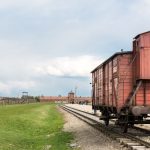
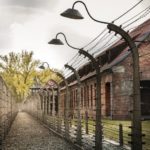
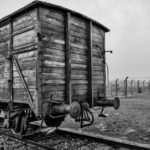
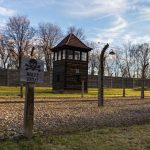
Much of what we know about Auschwitz comes from those who survived it. Their memoirs, testimonies and interviews describe what documents cannot: the journey in the cattle cars, the selection on the ramp, hunger, fear, friendship and loss. As the last survivors pass away, these books and recordings become the most important way to hear their voices. This article presents some of the best-known and most important accounts of Auschwitz.
Why survivor testimonies matter
The SS tried to destroy the evidence of its crimes. Most of the victims of Birkenau were never registered, and in January 1945 the SS burned documents and blew up the gas chambers. The testimonies of survivors, given after the war to courts, historical commissions and later to archives, are among the main sources on how the camp worked. They were used as evidence in trials, including the trial of the camp commandant Rudolf Höss and the Frankfurt Auschwitz trials. Read more in our article on the SS at Auschwitz and their trials.
Testimonies also show what statistics cannot: that each of the 1.1 million victims was a person with a name, a family and a life before the war.
Classic memoirs
Primo Levi, “If This Is a Man” (also published as “Survival in Auschwitz”). Levi, a young Italian Jewish chemist, was deported to Auschwitz in 1944 and worked in the Monowitz camp. His book, first published in 1947, is a calm and precise account of life and death in the camp, and one of the most important books about the Holocaust. In later works, especially “The Drowned and the Saved”, he reflected on what Auschwitz meant.
Elie Wiesel, “Night”. Wiesel was deported from Hungary to Auschwitz in 1944 as a teenager, together with his family. His short memoir of the deportation, the camp, the death march and the last months in Buchenwald, where his father died, has been read by millions of people around the world. Wiesel later received the Nobel Peace Prize in 1986.
Viktor Frankl, “Man’s Search for Meaning”. Frankl, a Viennese psychiatrist, passed through Auschwitz and several other camps. The first part of his book describes his experience in the camps; the second presents his ideas about finding meaning even in the worst suffering.
Tadeusz Borowski, “This Way for the Gas, Ladies and Gentlemen”. Borowski, a Polish poet, was a political prisoner in Auschwitz. His short stories, written soon after the war, describe the camp from the point of view of a prisoner who survives by adapting to it. They are among the harshest and most disturbing texts about Auschwitz.
Voices from inside the killing process
Filip Müller, “Eyewitness Auschwitz: Three Years in the Gas Chambers”. Müller, a Slovak Jew, was forced to work in the Sonderkommando near the gas chambers and crematoria and was one of very few members to survive. His testimony, published in 1979, is a rare account of the heart of the killing process. Read more about the Sonderkommando revolt of October 1944.
Rudolf Vrba, “I Escaped from Auschwitz”. Vrba was one of the two prisoners whose escape in April 1944 produced one of the most detailed reports on the gas chambers to reach the outside world. His memoir tells the story of his time in the camp and the escape. Read more about escapes from Auschwitz.
Women’s accounts
Charlotte Delbo, “Auschwitz and After”. Delbo, a member of the French resistance, was deported to Auschwitz in January 1943 with a transport of French women political prisoners, few of whom survived. Her trilogy, written in a mix of prose and poetry, is one of the most powerful literary works about the camp.
Seweryna Szmaglewska, “Smoke over Birkenau”. Szmaglewska, a Polish political prisoner, wrote one of the first accounts of the women’s camp in Birkenau, published in 1945. She later testified as a witness at the Nuremberg trials.
Edith Eger, “The Choice”. Eger was deported from Hungary to Auschwitz in 1944 as a sixteen-year-old. Decades later, after becoming a psychologist in the United States, she wrote about her experience and about healing from trauma.
Children who survived
Few children survived Auschwitz, but some of them later wrote about it. Accounts by former child prisoners, among them twins who survived the experiments of Josef Mengele, describe the camp through the eyes of the youngest victims. Read more in our article on children in Auschwitz.
Recorded testimonies
Beyond books, tens of thousands of survivors have recorded their stories on video.
- USC Shoah Foundation. Founded in 1994 by the film director Steven Spielberg, its Visual History Archive holds more than 55,000 video testimonies of Holocaust survivors and witnesses.
- Fortunoff Video Archive for Holocaust Testimonies. At Yale University, it is one of the oldest collections of video testimonies, started in the late 1970s.
- Auschwitz-Birkenau Memorial. The Memorial’s archive holds thousands of testimonies and memoirs of former prisoners, many of them published by its own publishing house.
Many of these testimonies can be watched online and are used by teachers around the world.
How to read testimonies
Each testimony is a personal memory, written or recorded months or decades after the events. Survivors sometimes remember dates, numbers or names differently, and historians compare testimonies with each other and with documents. This does not make them less valuable. Together, they give a picture of Auschwitz that no single document could.
Reading at least one memoir before a visit to the Memorial helps many visitors understand what they see. For the background, start with our short history of Auschwitz-Birkenau.
Frequently asked questions
Among the best known are Primo Levi’s If This Is a Man, Elie Wiesel’s Night, Viktor Frankl’s Man’s Search for Meaning and Tadeusz Borowski’s This Way for the Gas, Ladies and Gentlemen.
The USC Shoah Foundation’s Visual History Archive holds more than 55,000 video testimonies, and the Fortunoff Archive at Yale University holds another major collection.
The SS destroyed much of the evidence, and most victims were never registered. Testimonies are a key source on how the camp worked and were used as evidence in post-war trials.
Plan your visit to the Memorial
Visiting Auschwitz-Birkenau in person is the most powerful way to understand its history. We organise guided visits with licensed Memorial educators from Kraków, Warsaw, Prague, Vienna and other cities. See our tours