When people say “Auschwitz”, they usually mean a whole complex of camps rather than a single place. Nazi Germany built three main camps on the outskirts of Oświęcim: Auschwitz I, the original main camp; Auschwitz II-Birkenau, the largest camp and the main site of the mass murder of Jews; and Auschwitz III-Monowitz, a labour camp for a chemical plant. Around them grew a network of dozens of subcamps where prisoners were forced to work for German industry and agriculture.
| Auschwitz I | Auschwitz II-Birkenau | Auschwitz III-Monowitz | |
|---|---|---|---|
| Opened | Spring 1940 | Construction from October 1941 | Subcamp from October 1942 |
| Main role | Main camp, administration, prison | Extermination of Jews, largest concentration camp | Forced labour for IG Farben |
| Prisoners held | Mainly Poles at first, later all nationalities | Jews, Poles, Roma and Sinti, and others | About 10,000 at the end of 1944 |
| Today | Museum with exhibitions in the former blocks | Preserved grounds, barracks, ruins of the gas chambers | Almost nothing remains |
In November 1943 the SS reorganised the complex into three administratively separate camps, which is where the names Auschwitz I, II and III come from.
Auschwitz I: the main camp
Auschwitz I was set up in spring 1940 in former Polish army barracks on the edge of Oświęcim. The first mass transport, 728 Polish political prisoners from Tarnów, arrived on 14 June 1940. As the number of prisoners grew, the prisoners themselves were forced to enlarge the camp, adding new floors and new brick blocks.
Auschwitz I remained the administrative centre of the whole complex. The commandant’s office, the SS garrison headquarters and the camp Gestapo were based here.
Several places in Auschwitz I are closely tied to the history of the camp:
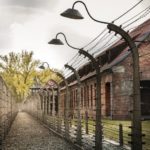
- The “Arbeit macht frei” gate. The inscription, “work sets you free”, greeted prisoners who were in fact being worked, starved and beaten to death.
- Block 11, the “Death Block”. The camp prison, with cells in its cellars where prisoners were starved to death or held in standing cells. In early September 1941 the SS tested Zyklon B here for the first time, murdering about 600 Soviet prisoners of war and 250 sick Polish prisoners.
- The Death Wall. In the courtyard between Blocks 10 and 11, the SS shot thousands of prisoners, most of them Poles.
- Block 10. The SS doctors carried out pseudo-medical experiments on women prisoners here.
- Crematorium I. The first crematorium of the complex, whose morgue was also used as a gas chamber before the mass killing was moved to Birkenau in 1942.
After the war the commandant Rudolf Höss was sentenced to death by a Polish court and hanged in 1947 at Auschwitz I, near the camp Gestapo building.
Auschwitz II-Birkenau
Birkenau was built about three kilometres from the main camp, on the site of the village of Brzezinka. Its Polish inhabitants were expelled and their houses demolished in 1941. Construction began in October 1941, carried out by around 10,000 Soviet prisoners of war brought to Auschwitz for the purpose. Most of them died within months from hunger, cold and abuse.
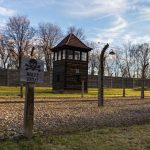
Birkenau was enormous. Within an area of about 140 hectares the Germans built some 300 buildings, more than 10 kilometres of roads and 16 kilometres of barbed-wire fencing. The camp was divided into sectors:
- BI, built in 1941–1942, with brick and wooden barracks; it held women prisoners for much of the camp’s history.
- BII, built in 1942–1943, made up of separate camps, among them the Theresienstadt family camp for Jews deported from the Terezín ghetto, the so-called Gypsy family camp for Roma and Sinti, the camp hospital, and “Kanada”, the storage barracks where the belongings of murdered victims were sorted.
- BIII, begun in 1943 and never completed, used in 1944 as a temporary camp for Hungarian Jewish women.
The gas chambers
The first gas chambers at Birkenau were two converted farmhouses, known as Bunker 1 and Bunker 2, in operation from 1942. From mid-1942 the SS built four large buildings that combined gas chambers and crematoria, known as Crematoria II, III, IV and V. The Germans planned them to murder and burn 1.6 million people a year.
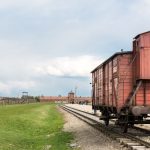
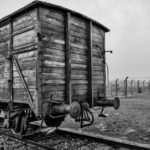
In May 1944, before the arrival of transports from Hungary, the SS opened a railway spur and an unloading ramp inside the camp, so that trains could stop a few hundred metres from the gas chambers. At this ramp SS doctors selected the few who would be registered for labour. The great majority of the 1.1 million victims of Auschwitz were murdered at Birkenau, most of them Jews.
Auschwitz III-Monowitz and the subcamps
The third main camp served German industry. In 1941 the chemical company IG Farben began building a large plant for synthetic rubber and fuel, the Buna-Werke, near the village of Monowice, a few kilometres east of the main camp. At first prisoners were marched there every day from Auschwitz I. In October 1942 a separate camp was opened next to the construction site, known as Buna and later as Monowitz.
Conditions were brutal. Prisoners worked long shifts on the construction site in all weather, with little food. Those who became too weak to work were sent to Birkenau to be murdered in the gas chambers. By the end of 1944 about 10,000 prisoners were held in Monowitz. One of them was the Italian chemist Primo Levi, whose book If This Is a Man describes life in the camp.
The subcamps
Around the three main camps the SS set up dozens of subcamps next to coal mines, steelworks, factories and farms across the region. Companies paid the SS for each prisoner they used. When the camp was evacuated in January 1945, columns of prisoners from these subcamps were also driven west on the death marches.
What can you see today?
The Auschwitz-Birkenau Memorial and Museum looks after both Auschwitz I and Birkenau, which are about three kilometres apart. A standard guided visit lasts about three and a half hours and covers both camps.
- In Auschwitz I visitors walk through the “Arbeit macht frei” gate and visit the exhibitions in the former blocks, which show the history of the camp, the evidence of the crimes and the belongings of the victims. Some blocks hold national exhibitions prepared by countries whose citizens were deported to Auschwitz. Block 11 and the Death Wall can also be visited.
- In Birkenau visitors see the main gate with the railway line, the unloading ramp, the wooden and brick barracks, and the ruins of the gas chambers and crematoria that the SS blew up in January 1945. At the end of the railway line stands the International Monument to the Victims of the Camp.
- Monowitz is not part of the Memorial. Almost nothing of the camp has survived, and the site lies partly on private land, though a few memorial plaques mark it.
To learn more about the history and the people of the camp, read our short history of Auschwitz-Birkenau and our article on the victims of Auschwitz.
All three camps were built and run by Nazi Germany in occupied Poland. Read why they are called German Nazi camps, not Polish camps.
Frequently asked questions
Auschwitz I was the original main camp, set up in 1940 in former army barracks. Birkenau, or Auschwitz II, was a much larger camp built from 1941 about three kilometres away, where most of the victims were murdered in the gas chambers.
About three kilometres. A guided visit to the Memorial covers both camps.
Monowitz is not part of the Memorial, and almost nothing of the camp remains. The site is marked by a few memorial plaques.
Dozens. They were located next to mines, factories and farms across the region, and most were attached to Monowitz after the complex was reorganised in November 1943.
The Germans chose a site with existing barracks, good railway connections and space to expand, in an area they had annexed to the Reich. These same railway connections later made it possible to bring deportees from all over Europe.
The Auschwitz-Birkenau Memorial publishes detailed information on each part of the camp.
Plan your visit to the Memorial
Visiting Auschwitz-Birkenau in person is the most powerful way to understand its history. We organise guided visits with licensed Memorial educators from Kraków, Warsaw, Prague, Vienna and other cities. See our tours