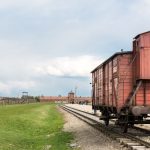
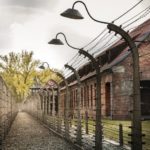
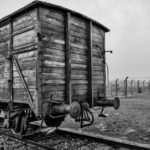
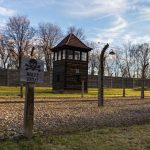
About 23,000 Roma and Sinti, men, women and children, were deported to Auschwitz between February 1943 and July 1944. Around 21,000 of them died there, in what is remembered by Roma communities as part of the Porajmos, the genocide of European Roma.
The order to deport
On 16 December 1942 Heinrich Himmler ordered the deportation of the Roma and Sinti still living in the German Reich to a concentration camp. In January 1943 the Reich Security Main Office named Auschwitz as the destination. The first transports arrived in February 1943. Most of the deportees came from Germany and Austria, from the Czech lands and from Poland, with smaller groups from other countries.
The “Gypsy family camp” in Birkenau
The Roma and Sinti were held in a separate sector of Birkenau, BIIe, known to the SS as the Zigeunerlager. As in the Theresienstadt family camp, families were kept together. The camp existed for 17 months.
Overcrowding, starvation and the lack of clean water led to constant epidemics, especially typhus and dysentery. In summer 1943 a disease called noma, which destroys the tissue of the face, spread among the children. More than 370 children were born in the camp; very few survived.
Not all Roma deportees were even registered. In March 1943 about 1,700 Polish Roma and Sinti were murdered in the gas chambers on arrival. In May 1943 about 1,000 more, suspected of carrying typhus, were selected for gassing.
Mengele and the Roma camp
From May 1943 the SS doctor Josef Mengele was chief physician of the Roma camp. He used its prisoners, especially twins and children, for so-called anthropological studies and pseudo-medical experiments. Many prisoners selected for his research were murdered, and their body parts were sent to institutes in Germany.
The night of 2 August 1944
In spring and summer 1944 the SS transferred some of the younger, stronger prisoners to camps in Germany. On 2 August 1944 the camp was liquidated. The remaining prisoners resisted, but the SS crushed their resistance and loaded them onto trucks. That night 2,897 men, women and children were murdered in the gas chambers.
Remembrance
Today 2 August is marked as the Roma and Sinti Genocide Remembrance Day, with a ceremony each year at the site of the former camp in Birkenau. In 2015 the European Parliament recognised the date as European Roma Holocaust Memorial Day. The Main Book of the Gypsy camp, buried by prisoners and recovered after the war, preserves some 21,000 names. More about the victims of Auschwitz can be found in our article, and the Auschwitz-Birkenau Memorial publishes further information on the history of the Roma camp.
Read more about the fate of the youngest prisoners in our article on children in Auschwitz, and about the other family camp in Birkenau, the Theresienstadt family camp.
Frequently asked questions
About 23,000 Roma and Sinti were deported to Auschwitz, and around 21,000 of them died there.
The SS liquidated the Roma family camp in Birkenau. That night 2,897 men, women and children were murdered in the gas chambers.
The Roma and Sinti Genocide Remembrance Day, marked each year at the Auschwitz-Birkenau Memorial and recognised by the European Parliament as European Roma Holocaust Memorial Day.
Plan your visit to the Memorial
Visiting Auschwitz-Birkenau in person is the most powerful way to understand its history. We organise guided visits with licensed Memorial educators from Kraków, Warsaw, Prague, Vienna and other cities. See our tours