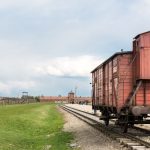
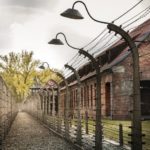
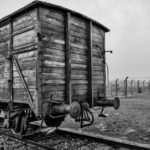
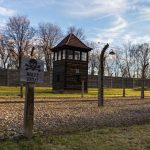
The Holocaust was the systematic, state-sponsored murder of six million Jews by Nazi Germany and its collaborators between 1941 and 1945. It did not begin with the gas chambers. It developed step by step, from discrimination and exclusion in Germany after 1933 to ghettos, mass shootings and, finally, the death camps. Auschwitz, where about one million Jews were murdered, became its largest site and its best-known symbol.
1933–1939: exclusion in Germany
When Adolf Hitler came to power in January 1933, about 500,000 Jews lived in Germany, less than one percent of the population. Within weeks the new regime organised boycotts of Jewish shops and began to remove Jews from the civil service, universities and professions. The Nuremberg Laws of 1935 stripped German Jews of their citizenship and banned marriages between Jews and non-Jews.
On 9 and 10 November 1938, during the pogrom known as Kristallnacht, synagogues were burned across Germany and Austria, Jewish homes and businesses were destroyed, and about 30,000 Jewish men were sent to concentration camps. Many Jews tried to emigrate, but few countries were willing to take them in.
1939–1941: occupation and ghettos
The German invasion of Poland in September 1939 brought about two million Polish Jews under German control. The occupiers forced Jews to wear armbands with the Star of David, seized their property and confined them in ghettos, among them the large ghettos in Warsaw and Łódź. Hunger and disease killed hundreds of thousands of people in the ghettos even before the deportations to the death camps began.
1941: mass shootings in the East
When Germany attacked the Soviet Union in June 1941, mobile killing units of the SS and police, the Einsatzgruppen, followed the army. Together with German police battalions, local collaborators and units of Germany’s allies, they shot Jewish men, women and children in mass executions near their towns and villages. At Babi Yar, near Kyiv, more than 33,000 Jews were murdered in two days in September 1941. By the end of the war, well over a million Jews had been shot in the occupied Soviet territories.
1942–1944: the death camps
From the end of 1941 the Nazi leadership moved towards the murder of all European Jews. In January 1942, at the Wannsee Conference near Berlin, senior officials met to coordinate the deportation of Jews from all over Europe. Killing centres with gas chambers were built in occupied Poland: Chełmno, Bełżec, Sobibór, Treblinka and Auschwitz-Birkenau. In these camps most deportees were murdered within hours of arrival.
Trains brought Jews from the ghettos of Poland and from almost every country under German control, from Norway to Greece and from France to Hungary. Auschwitz-Birkenau became the largest of the killing centres, particularly from 1943 onwards. Read more about the different types of camps in our article on concentration camps and extermination camps.
Resistance and rescue
Jews resisted in many ways: by smuggling food, keeping schools and prayer alive in the ghettos, hiding, escaping and fighting. In April 1943 the fighters of the Warsaw Ghetto rose up against the Germans, and there were revolts in Treblinka and Sobibór in 1943 and in Auschwitz-Birkenau in October 1944. Some non-Jews risked their lives to help; Yad Vashem has recognised more than 28,000 of them as Righteous Among the Nations.
1945: liberation and its aftermath
As the Allied armies advanced, the SS evacuated the camps and drove prisoners on death marches. Auschwitz was liberated by the Soviet army on 27 January 1945; camps in Germany such as Bergen-Belsen, Buchenwald and Dachau were liberated in April 1945. Survivors faced the loss of their families, homes and communities. Many could not return to where they had lived before the war and emigrated to Palestine, later Israel, the United States and other countries.
Six million
About six million Jews were murdered in the Holocaust, roughly two thirds of the Jews of Europe. Nazi Germany also persecuted and murdered other groups: Roma and Sinti, people with disabilities, Polish and Soviet civilians, Soviet prisoners of war, political opponents and others. Remembering the Holocaust means remembering all of them, while recognising that the destruction of the Jews was at the centre of Nazi ideology.
For more on the history of Auschwitz itself, read our short history of Auschwitz-Birkenau. The Holocaust Encyclopedia of the United States Holocaust Memorial Museum is an excellent place to learn more.
Read more about the evacuation of Auschwitz in our article on the death marches of January 1945.
Frequently asked questions
The systematic, state-sponsored murder of six million Jews by Nazi Germany and its collaborators between 1941 and 1945.
About six million, roughly two thirds of the Jews of Europe.
Auschwitz-Birkenau was the largest killing centre, where about one million Jews were murdered.
Plan your visit to the Memorial
Visiting Auschwitz-Birkenau in person is the most powerful way to understand its history. We organise guided visits with licensed Memorial educators from Kraków, Warsaw, Prague, Vienna and other cities. See our tours